One watch, from the ICU to the kitchen table.
Between the rooms, nobody is watching. A patient leaves the ICU, then the ward, then the hospital, and every hand-off drops something. Standing Watch is AI MedAgent stretched across the whole stay and the first 30 days home: the same reasoning layer in every room, a mediator on every finding so it reaches a person and gets an answer, and an encrypted bridge to the person's own phone. Three working demonstrations, on synthetic patients, follow the design pitch slide for slide.
The ICU watch board
Five synthetic beds. Each finding goes to a named role with a criticality and the reason for it, reminds, escalates, and records every step in FHIR. Send any bed's chart to the live reasoning and watch its findings get the same treatment.
Open the watch boardOne patient, five rooms
Follow Mrs. H from the ICU to the ward, discharge, home and past day 30. The clock slows from minutes to days, the recipient changes from the ICU nurse to Mrs. H herself, and the audit trail never breaks.
Follow Mrs. HDischarge to home, nothing in the clear
The going-home packet is encrypted in your browser and handed over as a SMART Health Link: a QR code that carries its own key. Ami opens it holding only a pseudonymous ID. The hospital keeps the mapping.
Cross the bridgeThe method, in four steps
The AI is the enabler here, and there is no reason to be shy about it. Decades of connectivity work got the data moving; it took a reasoning model to read it the way a clinician would, across rooms, at three in the morning, and say plainly what it could not check.
One watch, five rooms
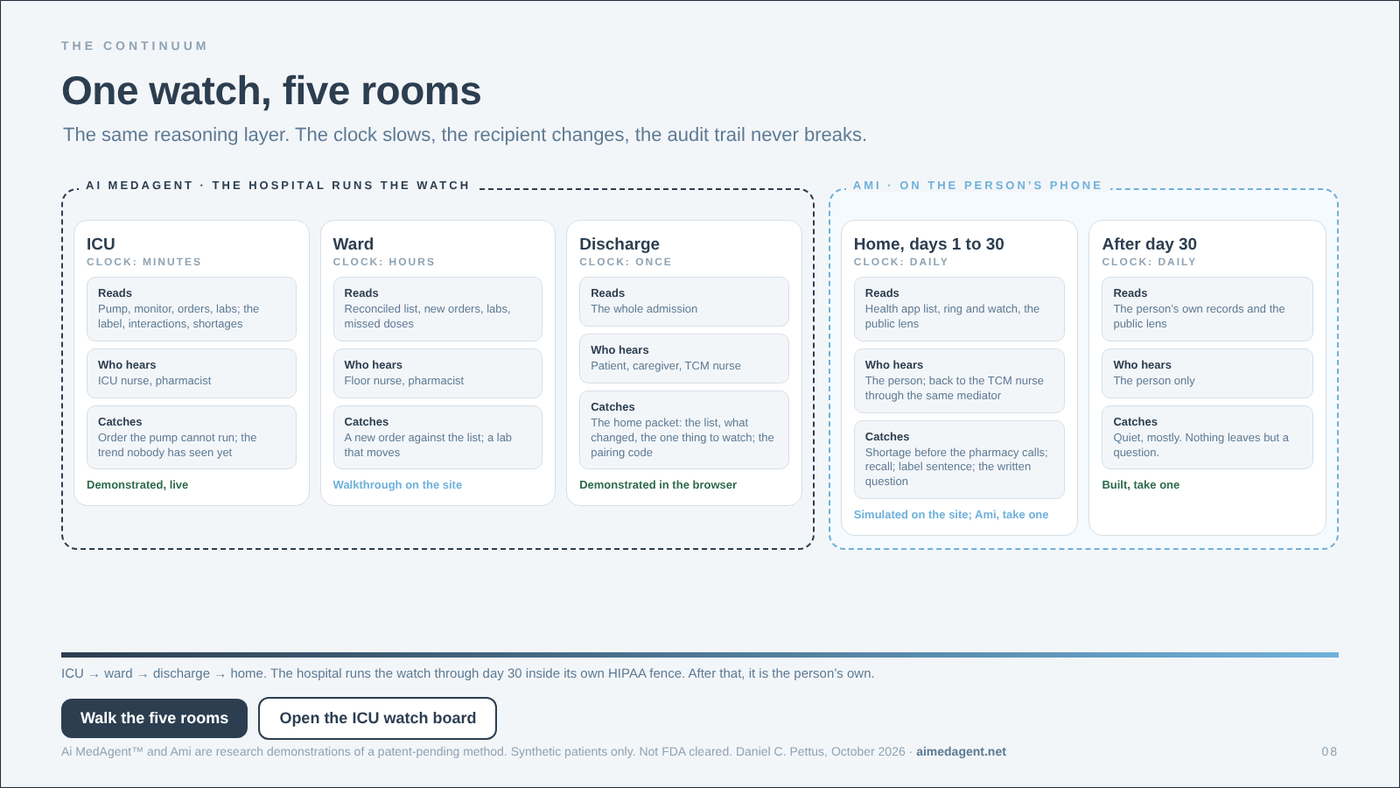
What runs today, and what is next
| Room | What you can do on this site | Status |
|---|---|---|
| ICU | Live reasoning on a synthetic chart with a simulated pump feed (Reasoning Demo, watch board); the mediator on every finding, in FHIR | Demonstrated, live |
| Ward | A new order against the list, caught and routed (five rooms) | Walkthrough, scenario findings |
| Discharge | The going-home packet and the pairing code, encrypted for real in your browser (the bridge) | Demonstrated in the browser; hosted blind server next |
| Home, days 1 to 30 | Ami's card and the question back to the nurse (five rooms, the bridge) | Simulated here; Ami built, take one, on iPhone |
| After day 30 | The person's own watch, quiet unless asked | Simulated here; Ami take one |
Next builds: the mediator delivered through a real channel (a CDS Hooks card first, then secure chat where an API exists); ward and discharge findings written by the live reasoning instead of scenario text; a hosted blind server for the bridge, with a passcode and the manifest request.
The design pitch and the datasheet
The pitch is the design document. Every demonstration on this page maps to a slide in it, and both are public.
Why "standing watch". The figure in the pitch is the company clerk in M*A*S*H, who heard the helicopters before anyone else did and had the paperwork ready when they landed. That is the job: hear it first, get it to the right person, and keep the record.
Limits, said plainly
This is a research demonstration of a patent-pending method, built and funded by one person. Synthetic patients only. It is not a medical device, is not FDA cleared, and is not for clinical use. A hospital that ran the watch for real would set its own recipients, timers and escalation chains, run it inside its own security boundary, and validate it before anyone relied on it.
Daniel Pettus spent forty years in medical device and health IT leadership at Alaris, CareFusion and BD, contributed to IHE Patient Care Device interoperability standards, and is named on two United States patents. He writes Inside the Loop at insidetheloopdp.substack.com and is the author of The Technology Was Never the Problem, at pettusbook.com.
AI MedAgent is a research demonstration of a patent-pending method. Advisory only. Not a medical device. Not for clinical use. Synthetic data only.