This one is not a mock-up.
AI MedAgent is now a registered Oracle Health app. It signs in through Oracle's own authorization server, reads the chart from Oracle's FHIR servers, takes live device data from an OpenBedside gateway running in the cloud, and reasons over both. Nothing runs on my desk. Two things are simulated, and they are labeled everywhere they appear: the pump and the patients.
What is real, and what is simulated
I have built enough demonstrations to know the first question a skeptic asks. So here is the whole ledger.
| Piece | Status | How you can tell |
|---|---|---|
| AI MedAgent as an Oracle Health app | REAL | Registered on 29 September 2026 in code Console, Oracle's free developer program. Oracle issued the application and client identifiers. No fee, no contract, nobody at Oracle had to say yes. |
| Sign-in | REAL | Oracle's authorization server issues the SMART on FHIR token. All twelve permissions the app asks for were granted. |
| The chart | REAL SERVERS SYNTHETIC PATIENTS | Read from Oracle's Millennium FHIR R4 servers: orders, medication administrations, dispensing, labs, allergies, problems, vital signs, encounters. The patients live in Oracle's shared developer sandbox. They are test records, edited by other developers, not people. |
| OpenBedside gateway | REAL, IN THE CLOUD | The open-source gateway, running as a cloud service. OpenBedside's own page, openbedside-demo.onrender.com, shows the pump and every message it sends, live. |
| The infusion pump | SIMULATED | OpenBedside's simulator. Oracle's sandbox has no live pump, monitor or ventilator feed, so this stands in for one, and every screen says so. |
| AI MedAgent reasoning | REAL | The same public service as the rest of this site. Deterministic screens plus a model, and every card says which one wrote it. |
| Listening with no clinician present | REAL, TESTED | A system login (SMART Backend Services) watched a patient for an hour on 29 September: twelve checks for changes, the token renewing itself. It still runs on a Mac; moving it to a scheduled cloud job is next. |
| The EHR screen around the app | ILLUSTRATION | A generic shell for a fictional hospital. It is not Oracle's interface. Only the AI MedAgent tab inside it is live. |
How it works
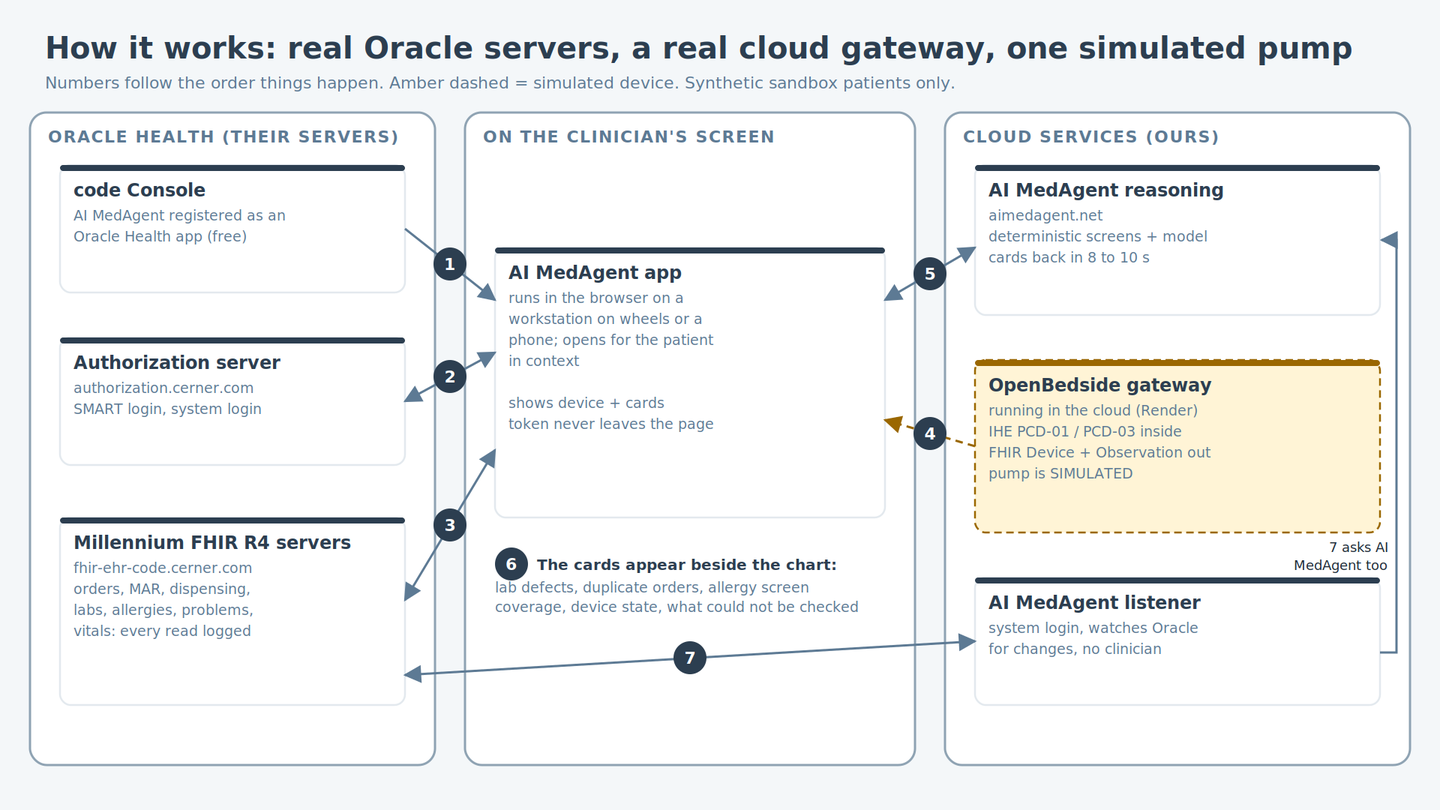
- Registered. AI MedAgent is an app in Oracle's developer program.
- Signed in. Oracle's authorization server issues the token. It stays in the browser.
- Read. The app reads the patient's chart from Oracle's FHIR servers, every request logged with its HTTP status.
- Device. OpenBedside, running in the cloud, publishes the pump's state as FHIR Device and Observation resources, with the patient it is bound to.
- Reason. The app sends one standard CDS Hooks request to AI MedAgent. No token goes with it.
- Show. Cards come back beside the chart in eight to ten seconds.
- Listen. Separately, a system login asks Oracle only for what changed, and asks AI MedAgent again when something did.
What it found in Oracle's own test data
The sandbox patient is a shared record that developers write to, so it is a mess. That turned out to be the most useful thing about it.
- Eight physiologically impossible laboratory values, all in one test. Not abnormal: impossible. In August the same sandbox returned potassium values below zero.
- An acetaminophen allergy on file beside multiple active acetaminophen orders.
- Twenty-three active orders naming the same product.
- An allergy screen that saturated: 28 text matches, which is not 28 contraindications, and the card says so.
- Two of eight medication safety classes ran, none against a licensed drug knowledge base. The coverage card says that on every patient, every time.
If this were a real chart, the record itself would be the patient's first safety problem. A reasoning layer that reads a negative potassium as a potassium is reasoning over a broken record, so AI MedAgent now says the record is broken before it says anything else.
Check it yourself
Open the hospital viewThe app with its request log
These public links read Oracle's open sandbox without a sign-in, so anyone can try them. The signed-in version, with the token and the twelve permissions, launches from Oracle's developer console under my registration; the request log on the app page shows which mode you are in.
- The hospital view has a Change patient button that searches Oracle's sandbox by name. Pick someone else and the pump card turns red: NOT this chart. The pump stays bound to its patient, and AI MedAgent is told it does not match. Wrong-patient association is one of the oldest problems in infusion, and this is how it should look when it happens.
- OpenBedside's live status page: openbedside-demo.onrender.com, the simulated pump and every HL7 message it sends to the stand-in EHR. It is on a free server that sleeps when idle, so the first visit can take a minute.
- AI MedAgent's service description, in the format any CDS Hooks client reads: aimedagent.net/cds-services.
- OpenBedside's source, including the cloud deployment: github.com/danielpettus/openbedside.
Eight gates, seven passed, zero dollars
| # | Gate | Result |
|---|---|---|
| 1 | A plain web page can read Oracle's servers from a browser | PASSED |
| 2 | Register the app in Oracle's developer program | PASSED |
| 3 | SMART on FHIR sign-in, launched by Oracle | PASSED |
| 4 | Read the whole chart, medication administrations and dispensing included | PASSED |
| 5 | Send the record to a reasoning service in the cloud | PASSED |
| 6 | Get back cards that say something useful | PASSED |
| 7 | Listen for changes with no clinician present | PASSED |
| 8 | An alert inside the clinician's own EHR screen | OPEN CDS Hooks is not publicly documented for Oracle Health. That is the one question left for Oracle. |
What this is not
- Not inside PowerChart or Oracle Health Foundation EHR. The app is launched from Oracle's developer launcher, or opened directly against the open sandbox.
- Not a hospital, not real patients, not a medical device.
- Not connected to Oracle's own device integration. Whether OpenBedside could feed it is untested.
- Not encrypted end to end. OpenBedside has no encryption of its own yet; the host's HTTPS is the only protection on the wire. That is why the data is synthetic, and why a hospital security officer would rightly want far more before real data came near it. That conversation is the point.
Earlier this month the same reasoning ran against VistA, the VA's open-source EHR, running on my own computer. The difference here is the other side of the wire: a commercial EHR vendor's live developer servers, a registered app, and a gateway that no longer needs anyone's desk. Every change, dated.
Daniel Pettus spent forty years in medical device and health IT leadership at Alaris, CareFusion and BD, contributed to IHE Patient Care Device interoperability standards, and is named on two United States patents. He writes Inside the Loop at insidetheloopdp.substack.com and is the author of The Technology Was Never the Problem, at pettusbook.com.
AI MedAgent is a research demonstration of a patent-pending method. Advisory only. Not a medical device. Not for clinical use. Synthetic data only.