What this is
Federal certification forced every electronic health record in the country to expose a standard interface, and it worked. Nothing equivalent exists for the devices at the bedside, and after twenty-two years of trying, nothing is coming. The reason is not technical. Every previous attempt asked device manufacturers to change a regulated product for a market that did not exist yet.
This memorandum proposes something much smaller, called PCD-E: a read-only endpoint on the gateway manufacturers already ship, returning a five-minute summary of what each device reported, plus the reason the numbers look the way they do. Not a stream. Not a sample. A summary, with context. Alarms bypass it and arrive immediately.
Then it stops asking. Rather than wait for a manufacturer to build an endpoint, I built the receiver, published the schema, and invited them to point a simulator at it. That costs about five dollars a month.
You can check that for yourself before you read another word, and without a key. This returns what the endpoint accepts and is generated by the deployed code, so it always describes what is actually running:
curl https://aimedagent.net/device
To send it something you need a key, and you issue your own. There is no approval step, no form, no waiting and nobody to email. It is free, there is nothing to sign, and there is no agreement, no fee and no NDA:
# no dependencies, needs only Node 18 or newer
curl -O https://aimedagent.net/pcde-client.mjs

# mints a key in your name, builds a synthetic five-minute pump
# window, sends it, and prints what came back. One command.
node pcde-client.mjs --org "Your Company" --demo
Or mint one directly, if you would rather point your own gateway at it:
curl -X POST https://aimedagent.net/device/key \
  -H 'Content-Type: application/json' \
  -d '{"organization":"Your Company"}'
Your company name goes inside the key, so a connection is attributable without a lookup and nobody has to keep a list. That is the only reason the key exists. It is a name tag, not a security boundary, because there is nothing behind the door worth forcing: the sandbox stores no data and only ever sees synthetic input.
The demo generates ten IHE PCD-01 messages over five minutes at 125 mL/h, drops the rate to 5 mL/h at 14:08, and resets the cumulative volume counter partway through. It touches no real data and needs no device. What comes back is the epoch and what a reasoning engine made of it.
If your gateway already emits PCD-01, that is the whole integration. Point it at /device/hl7 with a bearer token and send what you already send. The epoch arithmetic happens here.
Synthetic data only. The endpoint refuses anything carrying a patient name, a date of birth or an identifier outside a published synthetic allowlist, and it refuses it before the payload is stored, logged or read by a model. Nothing is retained.
Read the ingest specification (PDF, 14 pages)Version 0.4, 31 August 2026. Section 10a documents the conformance block the endpoint returns. GET /device returns current behavior and needs no key.
The problem, in one picture
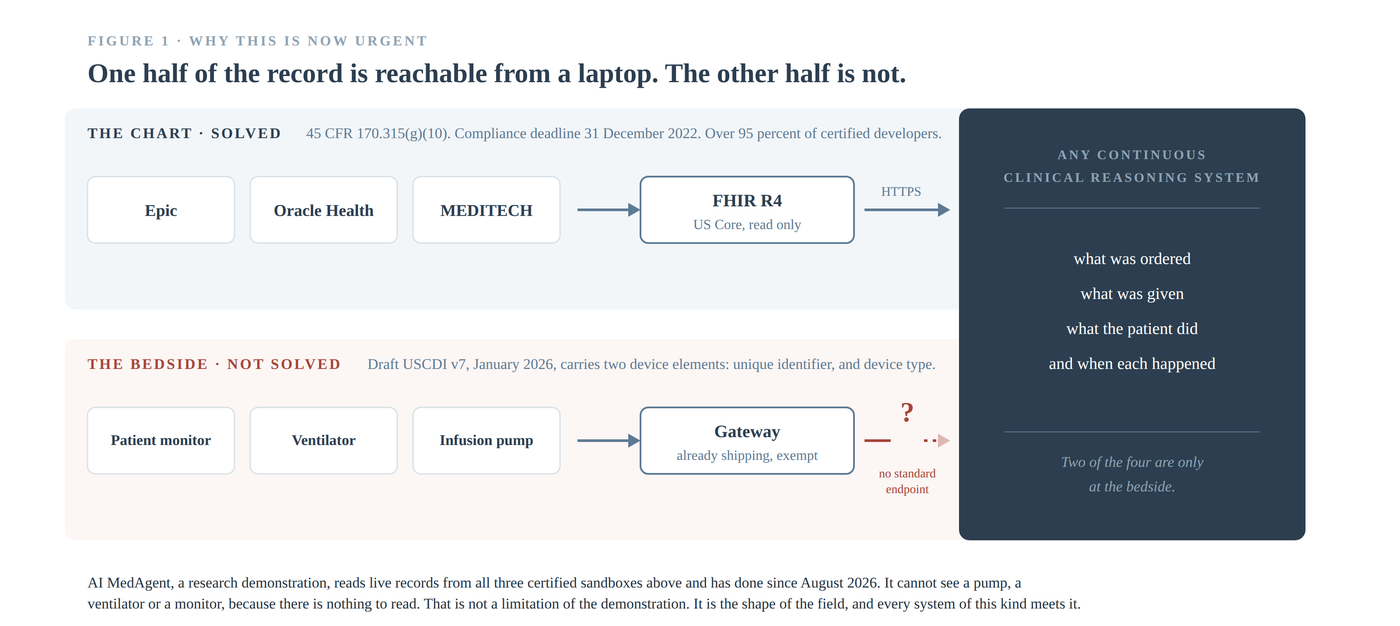
Any continuous clinical reasoning system needs four things: what was ordered, what was given, what the patient did in response, and when each happened. The first two are in the chart and the chart is now reachable from a laptop. The second two are only at the bedside.
The correction that makes it work
The obvious design is to poll each device every five minutes and record what it says. That design has a documented failure mode, and Julian Goldman photographed it in 2016: a patient monitor displayed an oxygen saturation of 84 percent at 14:07, the monitor alarmed, and the anesthesia record for the same period shows an unbroken line of normal saturations. His caption is two words. Sampling error.
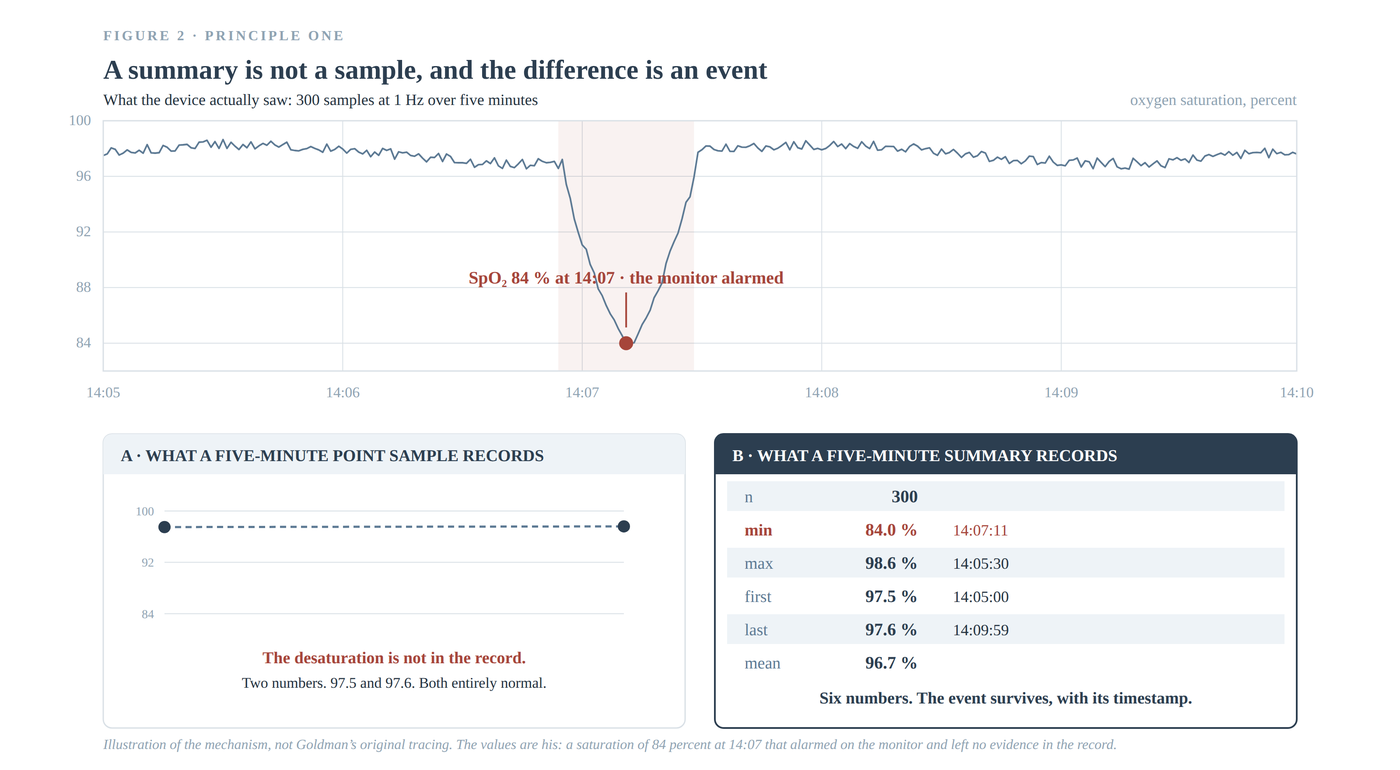
Illustration of the mechanism, not Goldman’s original tracing. The values are his. A five-minute point sample reproduces his failure exactly. A five-minute summary carrying count, minimum and its timestamp, maximum, first, last and mean does not, at a cost of four extra numbers.
What is in the memorandum
- Three corrections to my own starting assumptions, including the one that hurt: FDA reissued its clinical decision support guidance on 29 January 2026, and a five-minute epoch does not escape the device definition.
- Why the electronic health record side worked and the device side did not, with the West Health Institute’s own 2013 figure showing that 93 percent of the benefit accrues to providers and none of it to the manufacturers who were being asked to build.
- An inventory of every standard, profile, implementation guide and dataset that could be built on, with the status of each checked directly in August 2026 rather than taken from the literature.
- OpenICE taken apart properly. It is alive, its documentation is a decade old, its transport cannot cross a cloud boundary, and the runtime license committed in its own repository forbids commercial use.
- Seven design principles, the case for and the honest case against, and what to do next in order, cheapest first.
A proposal for a data interface, not for a clinical system. Nothing in it should be read as suggesting that a five-minute summary is sufficient for closed-loop control, for arrhythmia detection, or for any purpose requiring beat-to-beat fidelity. Those need waveforms and always will.
The claim is narrower and, I think, defensible: that a very large class of useful reasoning about where a patient is heading needs interval statistics and context rather than samples, and that the absence of an interface carrying interval statistics and context is why that reasoning is not happening.
Argue with it
Every number in the memorandum is sourced and most of them are checkable in an afternoon. If something in it is wrong I would rather hear it from you than from a comment thread. Corrections get published with the name of whoever caught it, which is how the Epic finding in the EHR datasheet got fixed.
Daniel Pettus · dan@aimedagent.net · feedback form